
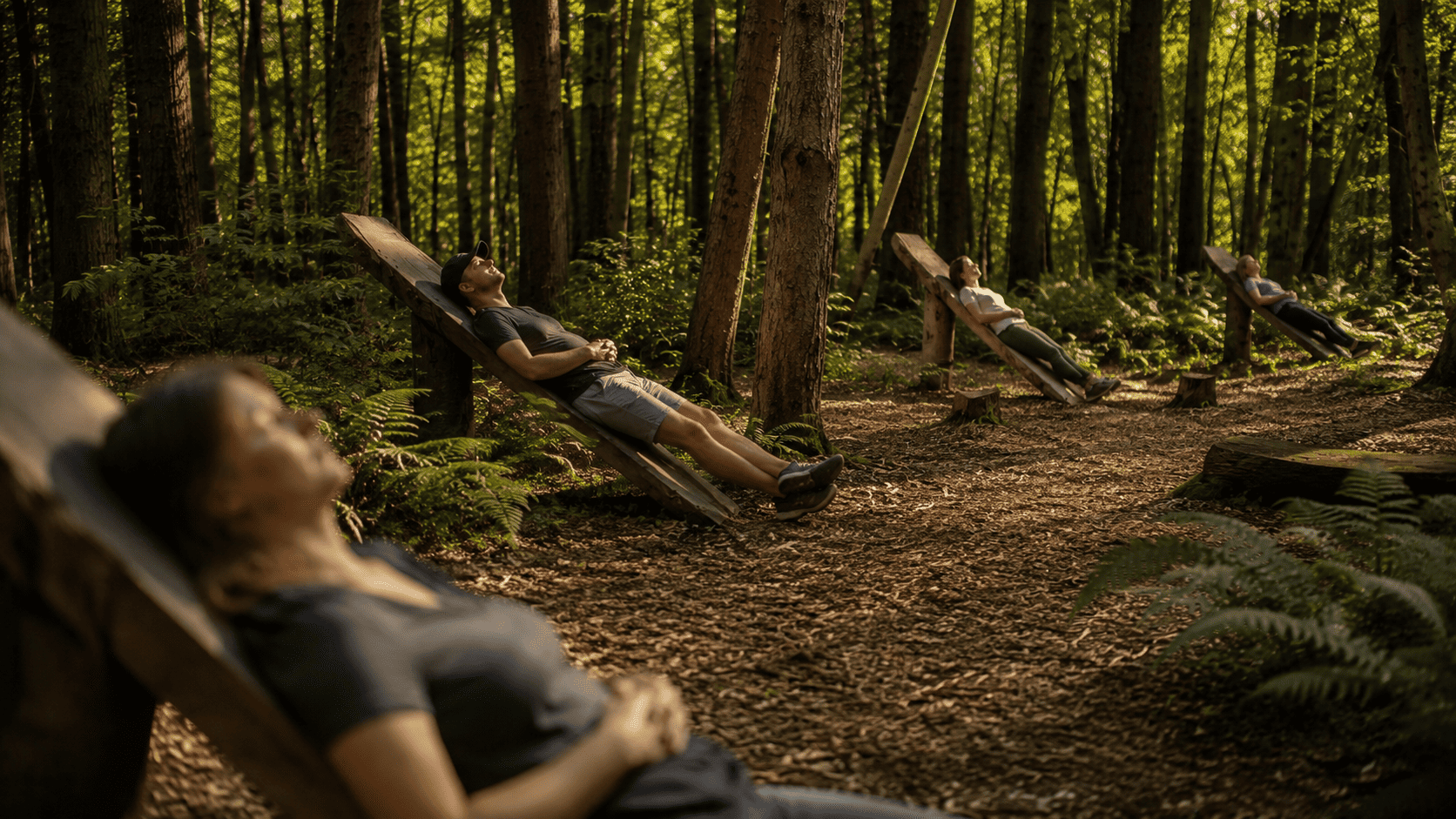
Somewhere between the second cup of coffee and the fifteenth open browser tab, most of us forget that we are animals. Animals that evolved to live among trees, to drink water from streams, to fall asleep when the sky got dark. The further we drift from that life, the harder our nervous systems work just to keep up.
This is why forest bathing — a Japanese practice called shinrin-yoku — has quietly become one of the most studied wellness practices of the last decade. Not because it’s exotic. Because it works.
What Is Forest Bathing, Exactly?
Forest bathing is not hiking. It’s not exercise. It’s not even really “doing” anything.
The practice was developed in Japan in the early 1980s, when public health researchers noticed that rural populations — even those who didn’t exercise much — had measurably lower rates of stress-related illness than their city counterparts. The hypothesis: simply being among trees was doing something for the body that the rest of modern life couldn’t.
The Japanese government invested in research. The results were striking enough that shinrin-yoku became an official part of national preventative healthcare in 1982.
In practice, forest bathing means slowly walking (or sitting) in a wooded area for at least two hours, engaging all five senses, with no destination, no goal, no phone, and no agenda. That’s it. That’s the whole thing.
The Science Behind the Stillness
If forest bathing sounds suspiciously like “just sitting in the woods,” consider what the research has found:
- Lower cortisol. A 2010 study in the journal Environmental Health and Preventive Medicine found that subjects in a forest had cortisol levels (the body’s main stress hormone) 12-15% lower than those who walked in urban environments.
- Higher NK cell activity. Natural killer (NK) cells are immune cells that help fight off viruses and even some tumors. Studies show their activity increases by up to 50% after a single weekend of forest bathing — and the effect lasts for up to a month.
- Lower blood pressure and heart rate. Multiple studies confirm consistent cardiovascular benefits, comparable to those of mild medication.
- Improved mood and focus. Subjects report feeling significantly less anxious, less depressed, and more mentally clear after sessions of two hours or more.
Researchers believe much of the benefit comes from phytoncides — airborne compounds released by trees as a natural defense against bacteria and insects. We breathe them in. Our immune systems respond. It’s medicine that’s been hiding in plain sight for a few million years.
How to Forest Bathe: The 5-Sense Practice
You don’t need a guide, a certification, or special equipment. You need a stretch of trees and two free hours. That’s it.
1. Go Slowly. Then Slower.
The single biggest mistake newcomers make is moving too fast. The whole point of forest bathing is that your nervous system has time to downshift. If you’re walking at your normal pace, your body is still in “go” mode. Try moving at about a quarter of your usual speed. If you’re not slightly bored, you’re still going too fast.
2. Engage Each Sense, One at a Time
Spend 10-15 minutes on each sense:
- Sight: Notice the way light filters through the canopy. The shapes of the leaves. The texture of bark. The color gradient from soil to sky.
- Sound: Close your eyes. Count how many distinct sounds you can identify. Wind. Birds. Insects. Your own breath.
- Smell: Get close to plants, soil, and tree trunks. Breathe deeply through the nose.
- Touch: Run your hands over different textures — smooth stones, rough bark, moss, leaves.
- Taste: If you’re somewhere safe, taste the air. (Skip if you’re uncertain about plants — we mean the air, not foraging.)
3. Sit Still for the Last 20 Minutes
Find a spot that feels right. A fallen log. A patch of moss. The base of a large tree. Sit. Don’t move. Don’t reach for your phone. Just exist in the place.
This is when most people report something shifting internally. The chatter in the head slows down. Time seems to soften. You notice things you hadn’t noticed in years.
Where to Forest Bathe
You don’t need to fly to Japan. You need somewhere with trees, ideally enough to feel surrounded. Good options include:
- Local nature reserves and forest parks.
- National forests (often free to enter).
- Quiet trails that aren’t overrun with hikers or mountain bikers.
- Even a large urban park, if you can find a section away from the path.
Pick somewhere you can return to. The benefits compound. The same forest in different seasons reveals different things.
What to Wear
Comfort is the only rule. You’ll be moving slowly, sitting, possibly leaning against trees. Tight, restrictive, or noisy synthetic fabrics work against the practice. What works:
- Soft, breathable cotton tees or tanks — nothing that distracts you with itch or stiffness.
- Loose, natural-fiber pants or shorts.
- Comfortable, broken-in shoes (walking shoes or even sandals if the trail allows).
- A light layer for cooler hours — mornings and dusk are some of the best times to forest bathe.
Earth tones tend to disappear into the environment and help you blend in — both visually and energetically. This is part of why we designed our Shift And Soul collection around forest greens, soft creams, and muted naturals: clothing that becomes part of the woods rather than fighting against them.
Bringing the Forest Home
You won’t always have two hours to spare. The good news is that even shorter “micro-doses” of nature offer measurable benefits.
- 20 minutes in a park measurably lowers cortisol.
- Houseplants and natural light at home improve mood and focus.
- Looking at images of nature — even on a screen — reduces sympathetic nervous system activity.
- Opening a window to hear birdsong, even briefly, signals safety to the brain.
The goal isn’t to escape modern life. The goal is to keep one foot rooted in the older, slower world that built us — even on the busiest days.
A Practice, Not a Hack
Forest bathing isn’t a productivity hack. It’s not going to make you a faster, sharper, more optimized version of yourself. It will do something better: it will help you remember that you don’t have to be optimized at all.
The forest is patient. It doesn’t ask anything of you. It just keeps doing what it’s been doing for millions of years — quietly making the air breathable, the water drinkable, and the nervous system calm.
All you have to do is show up.
Need comfortable, breathable layers for your next forest walk? Explore our women’s tank tops and men’s tank tops built for warm-weather outdoor wear.